The work - move the controls
Proof you can operate.
Five systems you can drive right here on the page. Change the inputs, watch the numbers recalculate, and check every claim against the date it was last verified.
One of them runs in production every day.
What makes it agentic, not just automated
A script does a task. A governed agent runs a loop.
Automation runs a step and stops. What every system below shares is a loop: it reads a live signal, recommends, waits at a boundary for a person when the stakes are real, acts, records what happened, and learns from the result. That loop is the difference between a tool bolted onto your process and a system that lives inside it. Click any stage.
A bolted-on script
- Runs one step, then stops
- No memory of the last run
- Acts or fails silently
- Nobody named on the outcome
A governed agent
- Runs the whole loop, continuously
- Remembers, and improves
- Stops at the boundary for a person
- Every call has a name and a trail
Step 1 of 6
Sense
The system reads a live signal on its own. Stock crossing a buffer, an invoice landing, a document arriving. It does not wait to be asked, which is the first thing a script cannot do.
Machine acts · AutomaticVendor Brain
One supplier with four identities, reconciled into one record.
Move the threshold →Live and interactiveMulti-site planning
Plan a shared part as islands or as one pool, and price the difference.
Flip the switch →In productionPersonal operating system
An always-on layer that runs the routine and stops at anything costly.
Run the queue →In daily useThe memory layer
What it may keep, and what happens when two facts collide.
Send a contradiction →Specified, not deployedAn expert team
Specialist seats that recommend. One person decides.
Open a seat →Vendor Brain
One real supplier, entered by hand into four different systems, four different ways. This finds them and merges them back into one record, and sends the borderline cases to a person instead of merging blind.
Nobody can answer how much the company actually spends with a vendor, everywhere, combined, because the same supplier is a different account number in every system. Five steps fix it: normalize, block, score, cluster, resolve. The first four are mechanical. The fifth is where a human belongs, and the control on the right is the line between them.
In production, in daily useDemo runs on stand-in vendorsWhat the control actually decides
Multi-site planning
Three plants, one shared long-lead part, and every item sorted into the policy its own demand pattern earns. Every figure computes in the browser from the inputs.
When each site plans alone, two of them buy the same part from the same supplier and neither can see the other's orders. The supplier reads two jumpy signals for one real demand, both sites cushion against the same risk, and one still runs out. Flip the switch and watch what one shared view is worth.
Live and interactiveStand-in manufacturer, for confidentialityGraded claims
- Every figure computes live in the browser from scenario inputs; change an input and the whole board recalculates
- How graded
- checked mechanically on the stated date
- Source
- the live demo at /demos/planning/ recomputes every figure from its scenario inputs; checked in a headless browser under the production CSP, 2026-07-20
- Every named statistical method cites its primary source
- How graded
- checked mechanically on the stated date
- Source
- the cited primary sources open live; verified 2026-07-20
- The pooling magnitude is a scenario input encoding partial correlation. The direction is a published result; the size is mine to defend
- How graded
- from the project's own records, not independently re-checked
- Source
- Eppen (1979) establishes the square-root pooling result; the magnitude here is my scenario input, labeled as such on the demo page
A personal operating system
Most people use AI one conversation at a time, which means they are the memory. An operating system is the layer underneath instead: always on, aware of your work, running the routine on a schedule, and stopping dead at anything that costs money.
The difference is hiring a freelancer for one job versus a chief of staff who already knows your priorities. One is convenient. The other changes what you spend your week on. The trick is that it has to be built as one thing from the start. Every version I have seen fail was a human app with AI bolted onto the side, and the joins are where the trust leaks out.
In productionWalkthrough on requestGraded claims
- Scheduled agents run the routine operational work: document ingest, calendar sync, provider cost tracking, and a weekly brief
- How graded
- checked mechanically on the stated date
- Source
- each scheduled function invoked directly, with its downstream effects read from the database, 2026-07-21
- Propose-then-approve runs end to end in the data pipeline: an agent proposes, a person signs, and the signature is what commits the change
- How graded
- from the project's own records, not independently re-checked
- Source
- from the project's own governance records, 2026-07-18
The memory layer
The interesting part sits on top of the operating system. Without memory you become the agent's memory, and the whole point is lost. With the wrong memory, it confidently tells you something that stopped being true in March.
Three questions decide whether remembering is an asset or a liability. What earns the right to be kept. What happens when a new fact contradicts an old one. Who can see it and who can change it. A contradiction supersedes, with a trail. It never quietly blends the two into an average nobody said.
In daily useWalkthrough on requestGraded claims
- Live in production with vector memory search, in daily use as my mobile interface to project status and open actions
- How graded
- from the project's own records, not independently re-checked
- Source
- deploy records and applied migrations verified 2026-07-08; on 2026-07-21 the delivery bot was confirmed present in its server with access to the channel it posts to, not a confirmed send; daily use is my own, not independently measured
- Full regression suite green at time of last verification
- How graded
- checked mechanically on the stated date
- Source
- test run, 2026-07-18
An expert team, sitting inside your work
Specialist seats attached to the projects and systems you already run. A finance seat that refuses to invent a number. A planning seat that names and cites the statistical method it used. An editor that gates anything going out under your name.
Across more than 1,600 execution traces from seven frameworks, roughly 42% of failures came from specification rather than model quality. Vague roles, no definition of done, unchecked authority. That is a management problem and a better model will not fix it. So the specification is the product, and every seat has to pass a written audition against cases with known answers before it is used at all.
A specification, not a running fleetGraded claims
- Every seat maps to a documented, published framework, and every cited source opens live
- How graded
- checked mechanically on the stated date
- Source
- the sources listed in the specification open live; verified 2026-07-20
- Ships as a self-contained static page, no external calls, rendered clean under production CSP
- How graded
- checked mechanically on the stated date
- Source
- served at /demos/ai-exec-team/ in the site build; loaded in a headless browser under the production CSP with zero console errors, 2026-07-18
- A specification, not a running fleet. Nothing is deployed and each seat ships only after passing a written audition
- How graded
- from the project's own records, not independently re-checked
- Source
- the specification's rollout and standing-law sections state the gate; no agent in the fleet is deployed
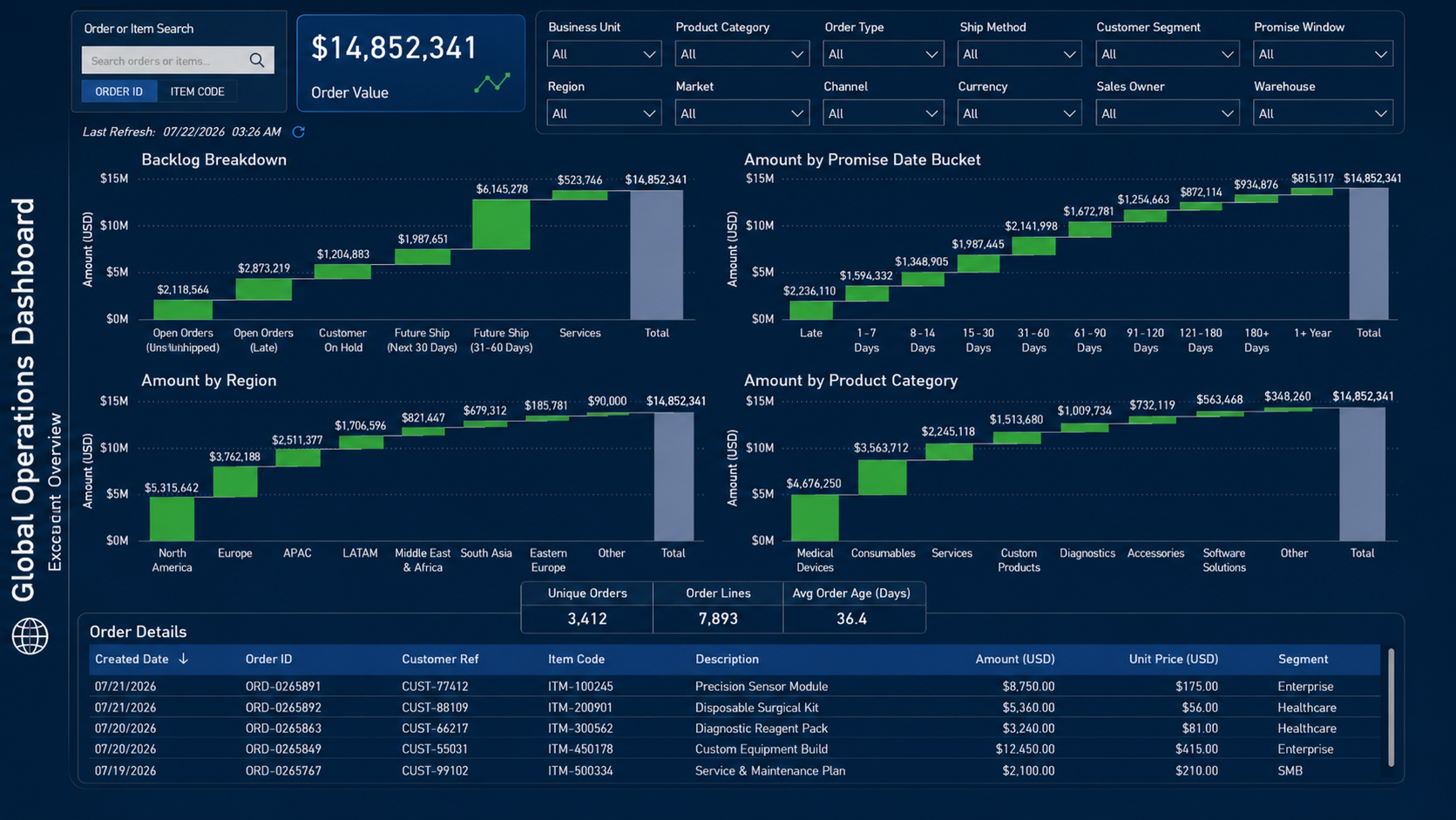
The layer everything else reports through
One trustworthy view, built on top of ten-plus systems.
Before an agent can be trusted with a decision, the numbers underneath it have to agree. This is the operational reporting layer I build for that: waterfalls for backlog and promise dates, region and category breakdowns, order-level detail, all reading from one reconciled source instead of ten that disagree. It is the unglamorous foundation the whole method sits on.
Why any of this transfers
The same discipline, on your problem.
The constraints here are the ones an operating company faces. Nobody outside can see the confidential inputs. Every number has to survive being questioned. The person who signs is accountable whether or not the model was right. I built these where I could prove the discipline first. What I would bring you is not these systems. It is the discipline that produced them, pointed at the decision that keeps going wrong in your business.